A welcome of Golden Foam
Guests arrived to a glass of Kavaklıdere Altın Köpük Brut, and the evening’s first word was Şerefe! (sheh-reh-FEH), Turkish for ‘cheers’.
Altın Köpük means ‘Golden Foam’. We’d been calling it Turkish Champagne all week, but legally it isn’t one. Only wine from France’s Champagne region can use that name. It’s made from Emir, a grape that grows almost nowhere outside Cappadocia. That’s the region of hot-air balloons and fairy-chimney rock towers, and the vines grow in the same volcanic soil. The bubbles are made in a sealed tank, as with Prosecco. The wine then rests on its yeast, which gives it a softer, creamier fizz.
In the glass it was pale gold, with white flowers, green apple and pear on the nose. On the palate it was crisp and dry, with a light biscuity note and a clean, stony finish. It’s often billed as Turkey’s first naturally sparkling wine, and it made a very good opener.
10,000 years in five minutes
With glasses in hand, we went through a whistle-stop history of what may be the world’s most underrated wine country.
The wild grapevine was first domesticated somewhere between eastern Anatolia and the Caucasus. People were making wine there around 10,000 years ago, so Turkish wine comes from very close to the birthplace of wine itself. Later, the Hittites poured wine as offerings to their gods near modern-day Ankara. After them, the Greeks and Romans planted vines along the Aegean coast and in Thrace.
Under the Ottomans, Muslims weren’t meant to drink, but Greek, Armenian and Jewish communities kept the craft alive. Our favourite twist came in the late 1800s. Phylloxera, a tiny vine pest, devastated France’s vineyards, and French merchants briefly bought huge amounts of Ottoman wine to fill the gap. Then the pest reached Anatolia too.
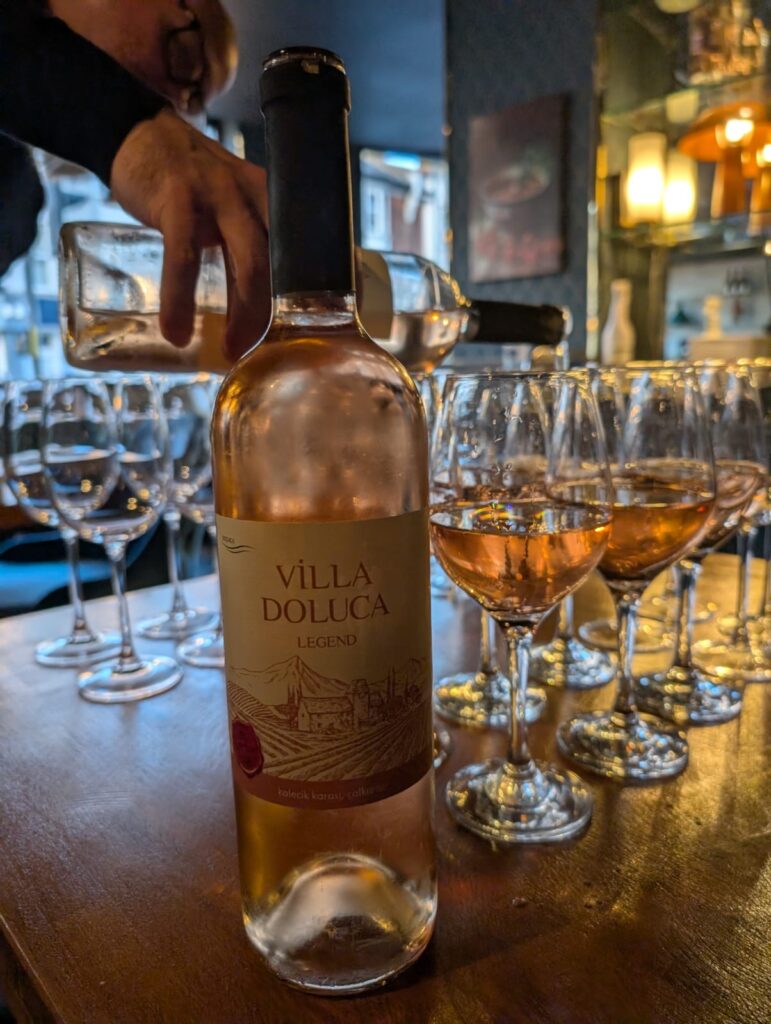
The modern chapter began after Atatürk founded the Republic in 1923 and encouraged winemaking. Turkey’s first private wineries followed within a few years. Two of them, Doluca (1926) and Kavaklıdere (1929), supplied our bottles for the night. Today Turkey is one of the world’s top five grape growers, yet only a sliver of the harvest becomes wine. Around 140 wineries are now reviving native grapes with wonderful names, such as Öküzgözü (‘ox eye’) and Boğazkere (‘throat-scratcher’).