A Night of Turkish Wine: Golden Foam, a Presidential White and a Rescued Red

We recently spent an afternoon travelling around Turkey without leaving Eastbourne. At the Turkuaz restaurant we explored sparkling wine, three still wines and some amazing Turkish food. Along the way we picked up 10,000 years of history, a grape rescued from extinction and a lot of very tricky pronunciation.

A welcome of Golden Foam

Guests arrived to a glass of Kavaklıdere Altın Köpük Brut, and the evening’s first word was Şerefe! (sheh-reh-FEH), Turkish for ‘cheers’.

Altın Köpük means ‘Golden Foam’. We’d been calling it Turkish Champagne all week, but legally it isn’t one. Only wine from France’s Champagne region can use that name. It’s made from Emir, a grape that grows almost nowhere outside Cappadocia. That’s the region of hot-air balloons and fairy-chimney rock towers, and the vines grow in the same volcanic soil. The bubbles are made in a sealed tank, as with Prosecco. The wine then rests on its yeast, which gives it a softer, creamier fizz.

In the glass it was pale gold, with white flowers, green apple and pear on the nose. On the palate it was crisp and dry, with a light biscuity note and a clean, stony finish. It’s often billed as Turkey’s first naturally sparkling wine, and it made a very good opener.

10,000 years in five minutes

With glasses in hand, we went through a whistle-stop history of what may be the world’s most underrated wine country.

The wild grapevine was first domesticated somewhere between eastern Anatolia and the Caucasus. People were making wine there around 10,000 years ago, so Turkish wine comes from very close to the birthplace of wine itself. Later, the Hittites poured wine as offerings to their gods near modern-day Ankara. After them, the Greeks and Romans planted vines along the Aegean coast and in Thrace.

Under the Ottomans, Muslims weren’t meant to drink, but Greek, Armenian and Jewish communities kept the craft alive. Our favourite twist came in the late 1800s. Phylloxera, a tiny vine pest, devastated France’s vineyards, and French merchants briefly bought huge amounts of Ottoman wine to fill the gap. Then the pest reached Anatolia too.

The modern chapter began after Atatürk founded the Republic in 1923 and encouraged winemaking. Turkey’s first private wineries followed within a few years. Two of them, Doluca (1926) and Kavaklıdere (1929), supplied our bottles for the night. Today Turkey is one of the world’s top five grape growers, yet only a sliver of the harvest becomes wine. Around 140 wineries are now reviving native grapes with wonderful names, such as Öküzgözü (‘ox eye’) and Boğazkere (‘throat-scratcher’).

Wine 1: Kavaklıdere Çankaya, the presidential white

Our first still wine came from Turkey’s first private winery. In 1929, Cenap and Sevda And had met in Switzerland and settled in Ankara. They bought vineyards in a leafy district called Kavaklıdere, which means ‘poplar valley’. The city eventually swallowed the vineyards, so in 1987 the winery moved out to Akyurt. It is still family-run, now in its fourth generation, with more than 1,300 medals and even two châteaux in Bordeaux.

Çankaya (CHAN-kai-ya) is named after the Ankara district that was home to Turkey’s presidential residence for most of the last century. It’s the country’s best-known white blend and a tour of Turkey in one glass:

  • Narince (35%), from Tokat, inland from the Black Sea. Its name means ‘delicately’, and it brings citrus and body.
  • Emir (35%), our volcanic Cappadocian friend from the fizz, for crisp acidity.
  • Sultaniye (30%), the grape behind sultanas and Turkey’s most planted variety, for roundness.

It poured pale straw, with lemon, white peach and pear on the nose. The palate was dry and lively, with a hint of spice and a clean, mineral finish. We asked the room whether they got more citrus or more stone fruit. There was no wrong answer.

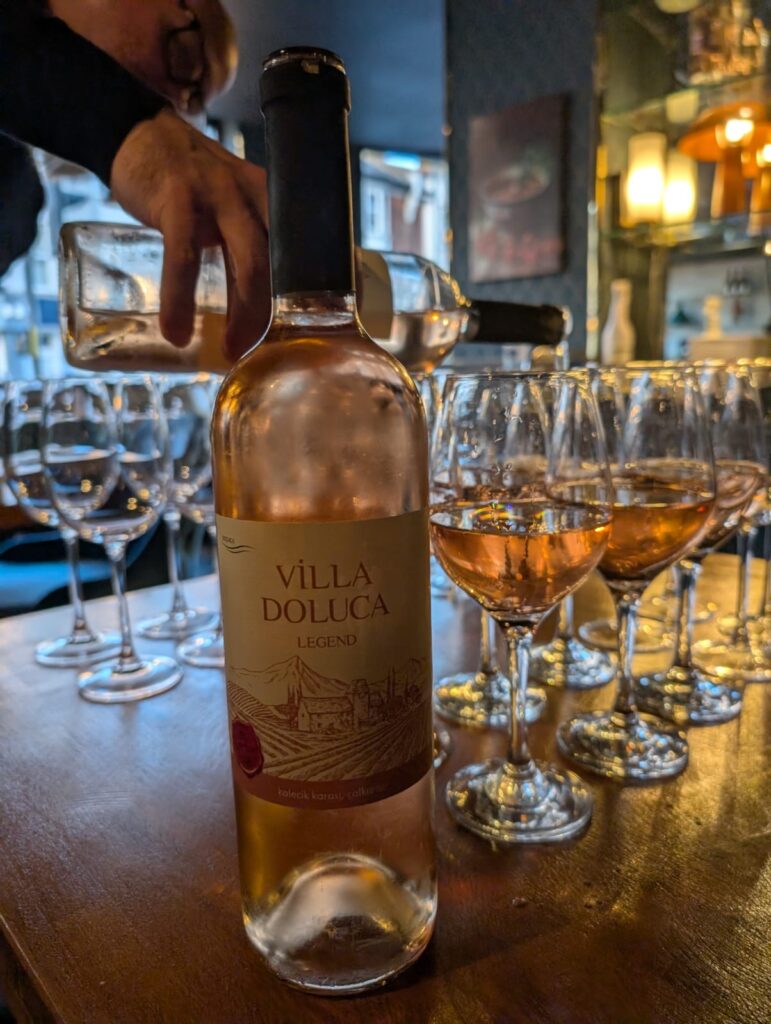
Wine 2: Villa Doluca Rosé

Next came Kavaklıdere’s great rival, which is three years older. Doluca’s founder, Nihat Kutman, was Turkey’s first formally trained winemaker; he studied at Geisenheim in Germany. In 1926 he opened a small wine house in Galata, Istanbul, and planted vineyards at Mürefte, on the Sea of Marmara. The brand is named after Doluca, the highest hill around. His son Ahmet, who trained at UC Davis in California, launched the Villa Doluca range around the start of the 1970s. It became Turkey’s most popular and prestigious wine, and the third generation of the family runs the company today.

The rosé blends two native red grapes. Kalecik Karası gives red-berry fruit. Çalkarası (CHAL-kah-rah-suh) means ‘the black grape of Çal’, a town in the Aegean hills. Its naturally pale skins make it practically born for rosé. The grapes are hand-picked, and only the free-run juice is fermented cool to keep the fruit fresh.

It was bright rose-petal pink, with strawberry, watermelon and a delicate hint of roses on the nose. The palate was dry and crisp, with juicy red berries and a touch of herbs. It’s fuller than a pale Provençal rosé, and at 13.5–14%, it’s one to sip rather than gulp.

Wine 3: Kalecik Karası, the red that nearly vanished

We finished the still wines with the night’s best story. Kalecik Karası (KAH-leh-jik KAH-rah-suh) means ‘the black grape of Kalecik’. Kalecik is a small town about 70 km from Ankara, on the Kızılırmak, the ‘Red River’ and Turkey’s longest river. Its baking summers, freezing winters and cool nights give the wine its freshness.

By the 1960s, phylloxera had all but wiped the grape out. Then, in the early 1970s, an Ankara University PhD student called Sabit Ağaoğlu chose it for his thesis. He found a handful of surviving vines and painstakingly propagated the healthiest ones. He is now known as the godfather of Kalecik Karası. Kavaklıdere later worked with the university to turn the rescued grape into a serious dry red. Today it’s one of Turkey’s big three native reds.

It’s often called Turkey’s answer to Pinot Noir, and the comparison holds up. It was a light, see-through ruby, with cherry, strawberry, a little spice and the grape’s signature note: candyfloss. The palate was smooth and juicy, with soft tannins and fresh acidity. We served it slightly cool, at about 15°C, to lift the fruit. And here’s the link back to Wine 2: this is the same grape that gave the rosé its red berries.

See our next events here
0 Your basket £0.00

Keep In Touch